Description
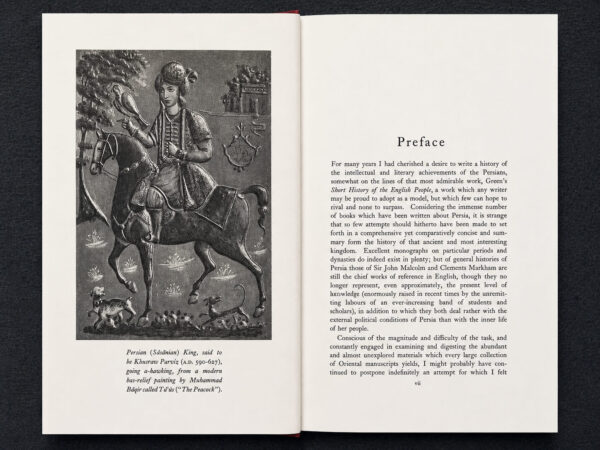
The classic work on the subject, A Literary History of Persia by E.G. Browne is still the standard work in the English language on the history of Persia and Persian literature. The book took roughly twenty-five years; complete and runs to 2,256 pages. Although its organizing thread is literature, the book is in practice a cultural history of Iran from prehistory to the twentieth century, ranging freely across religion, philosophy, science, historiography, and politics as it goes. It has never been superseded in English, and no comparable single-author survey of the tradition has been attempted since.
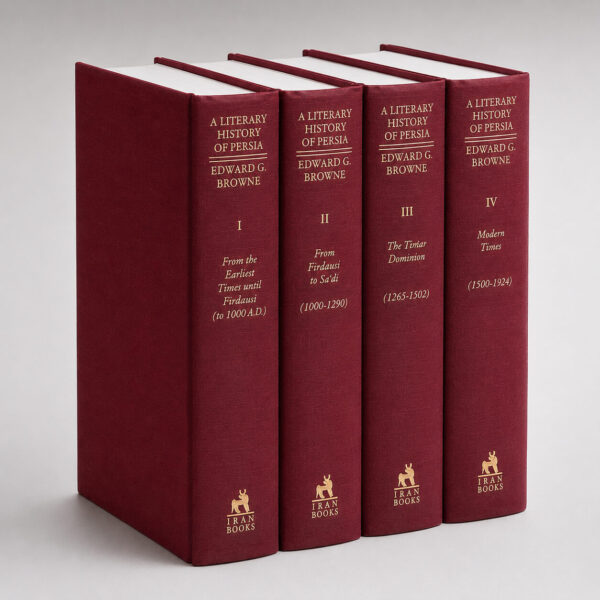
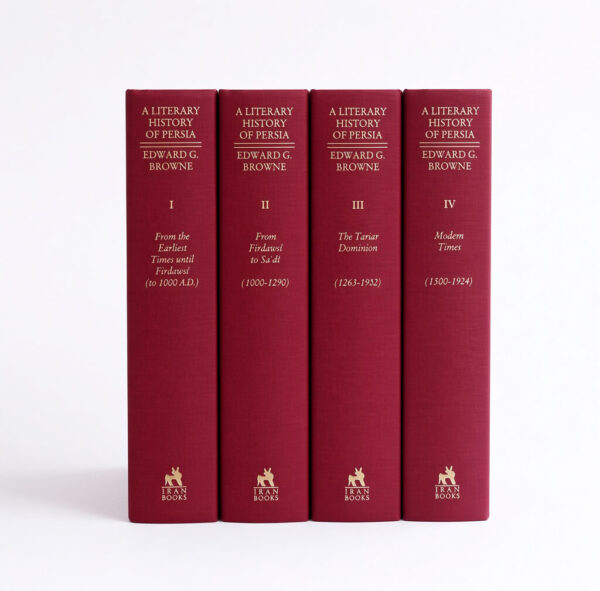
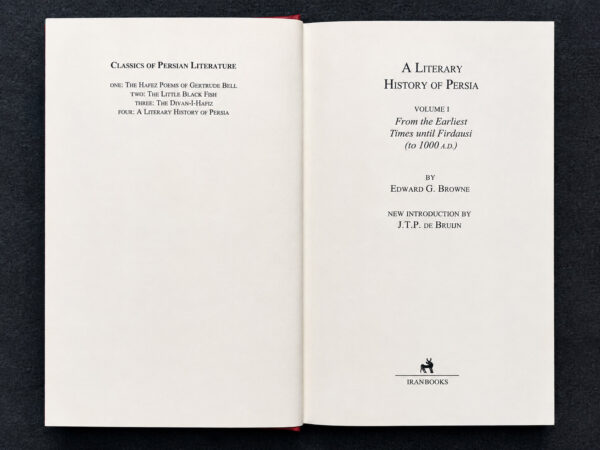
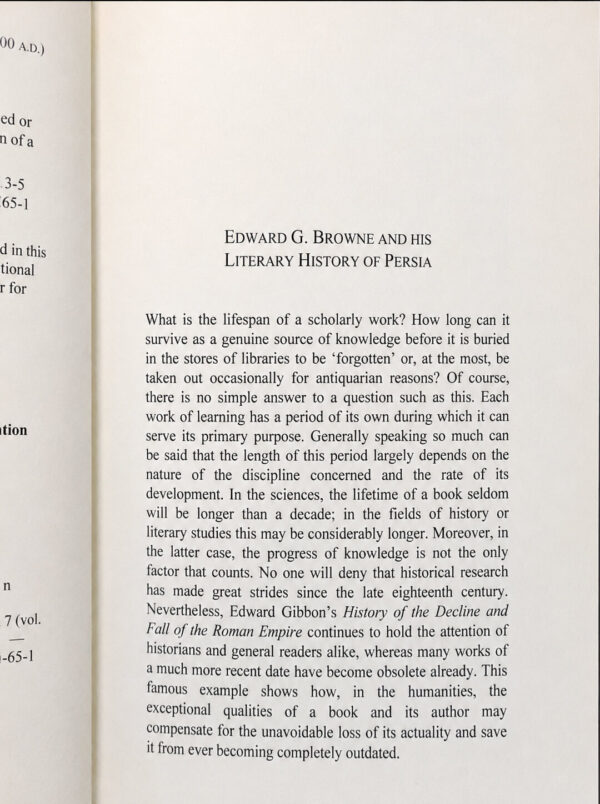
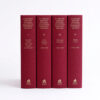
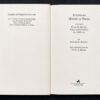
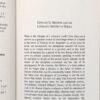
This edition is printed on acid-free paper and bound in a reinforced hardcover cloth cover in four volumes, as in the original. Professor J.T.P. de Bruijn (1931–2023) has contributed an insightful new introduction that surveys the history, significance, and continuing value of the work. It can still be used as a substantial reference work, but it can equally be read as Browne intended: as an invitation to discover the intellectual and literary civilization of Persia through the writings of the people who created it. The Ibex Publisher’s edition comprises four volumes and includes de Bruijn’s new introduction, bibliographical references, and indexes.
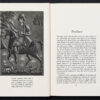
What has kept the work in print for more than a century is not only its scale but its manner. Browne wrote almost entirely from original Persian and Arabic sources, many of them manuscripts that were, at the time, accessible to no one but himself, and he wrote about them as a partisan rather than a cataloguer. The prose has a freshness and liveliness that continues to astonish readers who expect the dryness of a period reference work. He quotes generously and translates as he goes, so that the volumes double as an anthology: hundreds of passages of Persian verse rendered into English verse by Browne himself, from Rudaki and Ferdowsi through Omar Khayyam, Rumi, Saadi, and Hafez to the satirists and journalists of the Constitutional era. It is a book that can be used as a reference or read for pleasure.
The four volumes divide the tradition into periods. Volume One carries the story from Iranian pre-history and the Achaemenid inscriptions through the Sasanians, the Arab conquest, and the early Abbasid caliphate to the eve of the Ghaznavid age. Volume Two covers the classical flowering from Ferdowsi to Saadi, taking in the Seljuqs, the Assassins, Anwari, Khaqani, Nezami of Ganja, Attar, and Rumi, and closing with the Mongol catastrophe. Volume Three treats the Il-Khanid and Timurid centuries, the age of Hafez, Rashid al-Din, and Jami. Volume Four, the most personal of the set, follows Persia from the rise of the Safavids to the Qajar collapse, and ends with the poetry, prose, and press of the Constitutional Revolution — events Browne had himself championed in London.
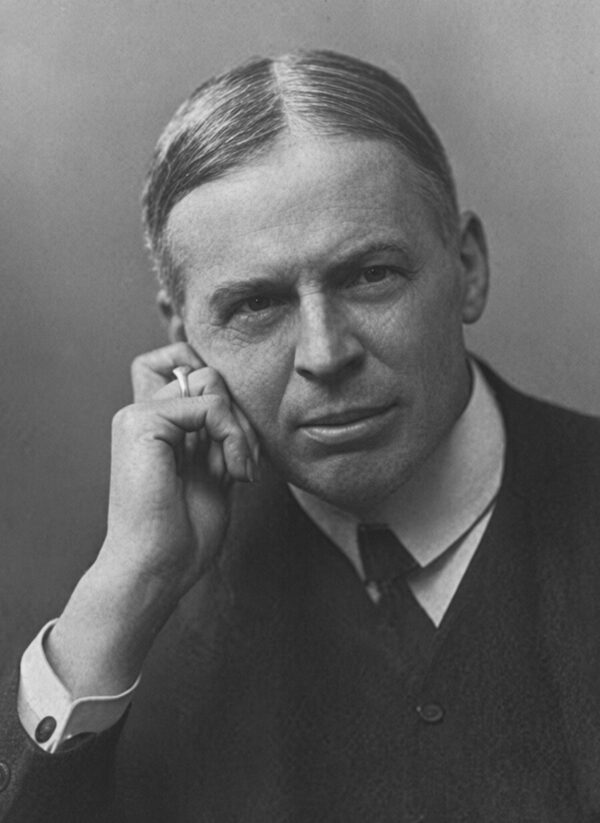
E.G. Browne created the field of Persian literary study in the English language. He trained as a physician but never practiced, having been diverted first into Turkish and then, decisively, into Persian and Arabic. A Pembroke fellowship allowed him a single year in Iran, from October 1887 to September 1888, during which he travelled to Tabriz, Tehran, Isfahan, Shiraz, Yazd, and Kerman, avoiding European society in favor of the company of poets, dervishes, and mystics resulting in A Year Amongst the Persians which remains one of the finest travel books written about the country. He was appointed University Lecturer in Persian at Cambridge and Sir Thomas Adams’s Professor of Arabic. He was also the principal Western authority on Babism, and the only European scholar to meet Baha’u’llah. Beyond scholarship he was an outspoken advocate for Iranian constitutionalism and against Russian and British encroachment, work for which he was awarded the Order of the Lion and the Sun and honored on his sixtieth birthday with an illuminated address from admirers in Iran. A street in Tehran still bears his name. Persians continue to remember him as one of the great foreign friends of their country.
J.T.P. De Bruijn studied Semitic languages, Islamic studies, Persian, and Turkish at Leiden, served as curator of the Middle Eastern collections at the Rijksmuseum voor Volkenkunde, and taught at Leiden University from 1964 until 1995 as professor of Persian language and culture. Few scholars were better placed to explain what Browne achieved, and why he still cannot be replaced.
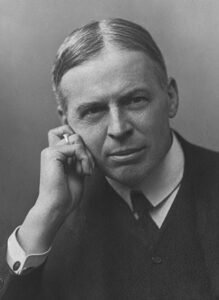 EDWARD GRANVILLE BROWNE (1862-1926) needs no introduction to those interested in Iran, Persian literature, Iranian history, Babism, Baha'ism or Sufism. He taught at Cambridge University and may be considered as the creator of what is now known as Iranian studies. A Literary History of Persia is his most important work.
![Memoirs of Ardeshir Zahedi, Vol. I [English]](https://ibexbooks.com/wp-content/uploads/2026/02/Memoirs-of-Ardeshir-Zahedi-Vol.-1-eng.jpg "Memoirs of Ardeshir Zahedi, Vol. 1 eng")
![Lessons of History [Persian Language]](https://ibexbooks.com/wp-content/uploads/2026/02/Lessons-of-History-300x450.jpg "Lessons of History")