Description
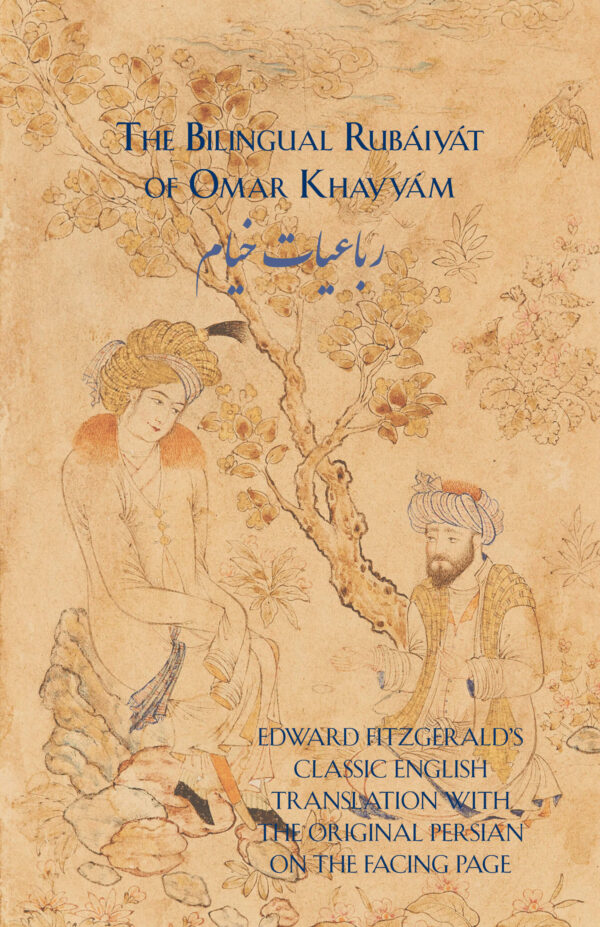
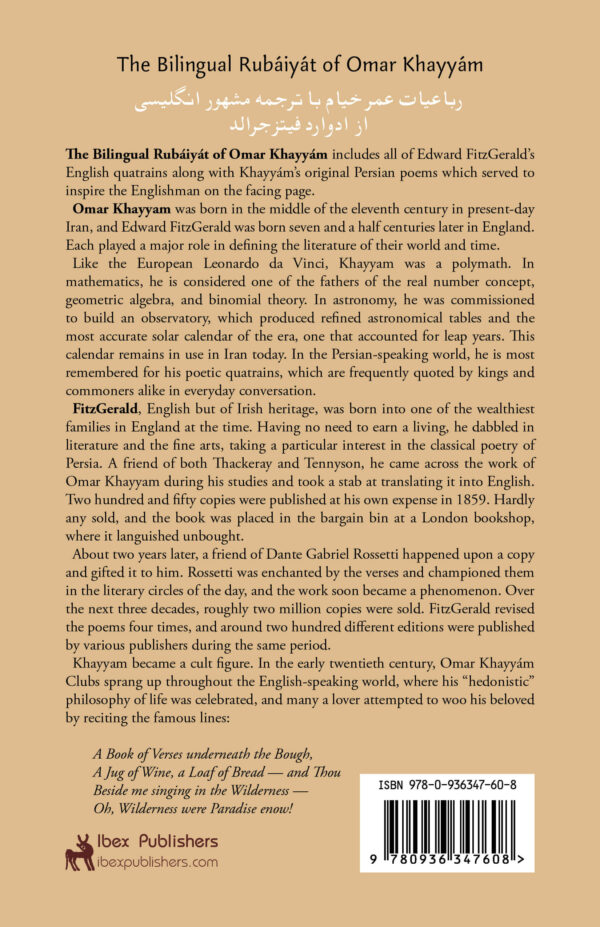
The Bilingual Rubáiyát of Omar Khayyám includes all of Edward FitzGerald’s English quatrains along with Khayyám’s original Persian poems which served to inspire the Englishman on the facing page.
Omar Khayyam was born in the middle of the eleventh century in present-day Iran, and Edward FitzGerald was born seven and a half centuries later in England. Each played a major role in defining the literature of their world and time.
Like the European Leonardo da Vinci, Khayyam was a polymath. In mathematics, he is considered one of the fathers of the real number concept, geometric algebra, and binomial theory. In astronomy, he was commissioned to build an observatory, which produced refined astronomical tables and the most accurate solar calendar of the era, one that accounted for leap years. This calendar remains in use in Iran today. In the Persian-speaking world, he is most remembered for his poetic quatrains, which are frequently quoted by kings and commoners alike in everyday conversation.
FitzGerald, English but of Irish heritage, was born into one of the wealthiest families in England at the time. Having no need to earn a living, he dabbled in literature and the fine arts, taking a particular interest in the classical poetry of Persia. A friend of both Thackeray and Tennyson, he came across the work of Omar Khayyam during his studies and took a stab at translating it into English. Two hundred and fifty copies were published at his own expense in 1859. Hardly any sold, and the book was placed in the bargain bin at a London bookshop, where it languished unbought.
About two years later, a friend of Dante Gabriel Rossetti happened upon a copy and gifted it to him. Rossetti was enchanted by the verses and championed them in the literary circles of the day, and the work soon became a phenomenon. Over the next three decades, roughly two million copies were sold. FitzGerald revised the poems four times, and around two hundred different editions were published by various publishers during the same period.
Khayyam became a cult figure. In the early twentieth century, Omar Khayyám Clubs sprang up throughout the English-speaking world, where his “hedonistic” philosophy of life was celebrated, and many a lover attempted to woo his beloved by reciting the famous lines:
A Book of Verses underneath the Bough,
A Jug of Wine, a Loaf of Bread — and Thou
Beside me singing in the Wilderness —
Oh, Wilderness were Paradise enow!
![Memoirs of Ardeshir Zahedi, Vol. II (1954-1965) [Persian Language]](https://ibexbooks.com/wp-content/uploads/2026/02/Memoirs-of-Ardeshir-Zahedi-Vol.-2-pers.jpg "Memoirs of Ardeshir Zahedi Vol. 2 pers")
![Memoirs of Ardeshir Zahedi, Vol. II [English]](https://ibexbooks.com/wp-content/uploads/2026/02/Memoirs-od-Ardeshir-Zahedi-2-engl-300x450.jpg "Memoirs od Ardeshir Zahedi 2 engl")