Description
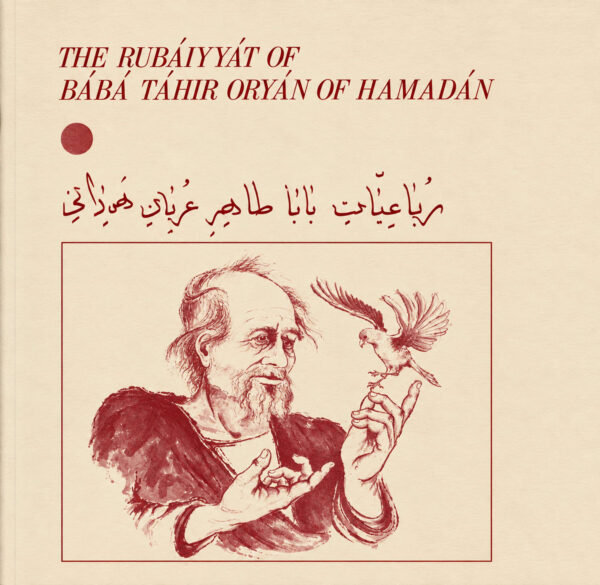
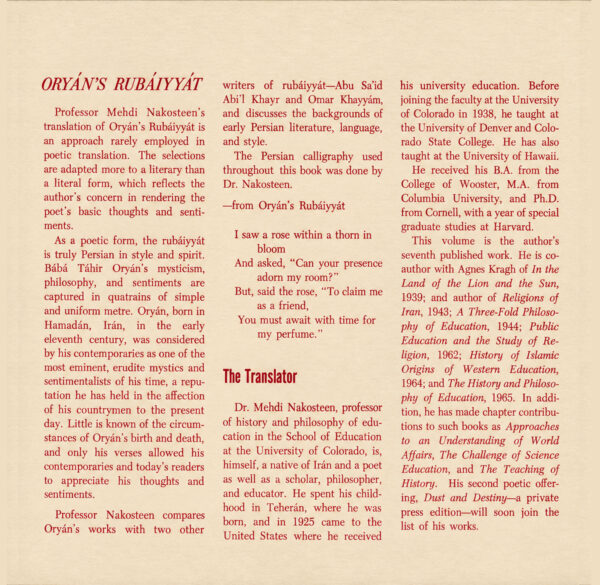
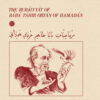
Mehdi Nakosteen’s translation of Oryán’s Rubáiyyát is an approach rarely employed in poetic translation. The selections are adapted more to a literary than a literal form, which reflects the author’s concern in rendering the poet’s basic thoughts and sentiments.
As a poetic form, the rubáiyyát is truly Persian in style and spirit. Bábá Táhir Oryán’s mysticism, philosophy, and sentiments are captured in quatrains of simple and uniform metre. Oryán, born in Hamadán, Irán, in the early eleventh century, was considered by his contemporaries as one of the most eminent, erudite mystics and sentimentalists of his time, a reputation he has held in the affection of his countrymen to the present day. Little is known of the circumstances of Oryán’s birth and death, and only his verses allowed his contemporaries and today’s readers to appreciate his thoughts and sentiments.
Professor Nakosteen compares Oryán’s works with two other writers of rubáiyyát—Abu Sa’id Abi’l Khayr and Omar Khayyám, and discusses the backgrounds of early Persian literature, languages, and style.
The Persian calligraphy used throughout this book was done by Dr. Nakosteen.
—from Oryán’s Rubáiyyát
I saw a rose within a thorn in bloom
And asked, “Can your presence adorn my room?”
But, said the rose, “To claim me as a friend,
You must await with time for my perfume.”
Mehdi Nakosteen’s translation of Oryan’s rubaiyyat is an approach rarely employed in poetic translation. The selections are adapted more to a literary than a literal form, which reflects the author’s concern in rendering the poet’s basic thoughts and sentiments. As a poetic form, the rubaiyyat is truly Persian in style and spirit.
Author
Baba Tahir Oryan باباطاهر عریان همدانی
Mehdi Nakosteen مهدی نخستین
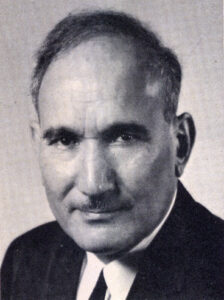 Mehdi Nakosteen has drawn on his intimate knowledge and understanding of both Eastern and Western cultures, as well as extensive research, in writing his History of Islamic Origins of Western Education.
He has written numerous books and articles about education and has been a contributor to the following major works: Approaches to an Understanding of World Affairs, published by the National Education Association in 1954, and The Challenge of Science Education, published by The Philosophical Library Publishers in 1959.
Born in Teheran, Iran, Professor Nakosteen came to the United States in 1925. He received his B.A. from the College of Wooster, M.A. from Columbia University, and Ph.D. from Cornell University. He also spent a year in special graduate study at Harvard University.
He has been on the faculty of the University of Colorado since 1938 and is now professor of history and philosophy of education in the School of Education at the University.
Dr. Mehdi Nakosteen, professor of history and philosophy of education in the School of Education at the University of Colorado, is, himself, a native of Irán and a poet as well as a scholar, philosopher, and educator. He spent his childhood in Teheran, where he was born, and in 1925 came to the United States where he received his university education. Before joining the faculty at the University of Colorado in 1938, he taught at the University of Denver and Colorado State College. He has also taught at the University of Hawaii.
He received his B.A. from the College of Wooster, M.A. from Columbia University, and Ph.D. from Cornell, with a year of special graduate studies at Harvard.
He is co-author with Agnes Kragh of In the Land of the Lion and the Sun, 1939; and author of Religions of Iran, 1943; A Three-Fold Philosophy of Education, 1944; Public Education and the Study of Religion, 1962; History of Islamic Origins of Western Education, 1964; and The History and Philosophy of Education, 1965. In addition, he has made chapter contributions to such books as Approaches to an Understanding of World Affairs, The Challenge of Science Education, and The Teaching of History.

![Memoirs of Ardeshir Zahedi, Vol. I [English]](https://ibexbooks.com/wp-content/uploads/2026/02/Memoirs-of-Ardeshir-Zahedi-Vol.-1-eng.jpg "Memoirs of Ardeshir Zahedi, Vol. 1 eng")
![Memoirs of Ardeshir Zahedi, Vol. II [English]](https://ibexbooks.com/wp-content/uploads/2026/02/Memoirs-od-Ardeshir-Zahedi-2-engl-300x450.jpg "Memoirs od Ardeshir Zahedi 2 engl")